
Forging Collaborations for Transformative and
Resilient Policy Solutions
Our 47th annual meeting, the 2025 APPAM Fall Research Conference, will be a multi-disciplinary research conference attracting the highest quality research on a wide variety of important current and emerging policy and management issues. The conference is comprised of special events, panels, cross-cutting and single track roundtables, workshops, and poster presentations and is designed to encourage substantive interaction among participants.
November 13 – 15, 2025 | Hyatt Regency | Grand Hyatt | Seattle, WA
Jump To:
Late Breaking Roundtables
Late-Breaking Roundtables submissions are now closed.
What is a Late-Breaking Roundtable?
A timely policy-related research topics that have arisen since submissions closed on April 23, 2025.
Roundtables do not include papers, but rather feature speakers who will discuss a topic from varying perspectives and draw the audience into a discussion on the topic. Late-Breaking Roundtable proposals should include up to four speakers plus a moderator. The moderator cannot be a speaker in the same session.
Examples of Late-Breaking Roundtables from #2024APPAM:
- Addressing Medical Debt in America: A Roundtable Discussion on Efforts to Remove Medical Debt from Credit Reports and Other Recent Policy Developments
- What’s on the Horizon for Federal Tax Policy in 2025?
- Let’s Get Building: How Can Local and State Governments Build More Homes, Produce Clean Energy, and Modernize Infrastructure?
What isn’t a Late-Breaking Roundtable?
Late-Breaking Roundtables are not a revision of a paper, panel, workshop, or roundtable submission that was rejected during the original submission period OR original research that is NOT topical or pressing in nature. Please note that only a limited number of Late-Breaking Roundtables will be accepted. Specific Submission Criteria will be listed in the All Academic portal.
Why are Late-Breaking Roundtables important?
We’ve had Late-Breaking Roundtables for the last two years, but they take on a new importance this year. There is a critical need for this kind of topical session at the Fall Conference to allow the research community the opportunity to discuss and debate what’s happening in Washington (and at the state and local level), to exchange information to further policy research, and collaborate on the next steps to move forward.
Questions? Email us.
Student Ambassadors
APPAM Student Ambassadors are active student members who are highly knowledgeable about the association and willing to share their time at the Fall Research Conference. Student Ambassadors help make the event a positive and welcoming experience for attendees, especially first-time conference goers. This role includes serving as panel chairs, hosting Ignite Sessions, assisting conference attendees, and serving and supporting the conference where needed.
*New in 2025!* All Academic Abstract Management System
New this year, APPAM is using All Academic as our conference submission platform. All conference participants (presenting authors, co-authors, panel chairs, discussants, moderators, speakers and session organizers) will access the All Academic system using an APPAM MemberClicks login. Before you begin your submission, please make sure that everyone that is part of your submission has an APPAM MemberClicks account. You will not be able to add them to your paper or session if they don’t have an existing account. Memberclicks account information:
- Please check to see if you have a MemberClicks account here.
- You can request your username or reset your password if you do not remember them.
- Please check any emails that you have had professionally/academically in the past few years, as well as any personal emails.
- If you think you may have an account under an email address you no longer have access to, please contact [email protected] for to update your email/username. Please do not create a new/duplicate account. If you have never attended an APPAM event or do not have an APPAM profile, you can create one here.
- APPAM membership is optional and is not required to submit or attend the conference. If you wish to proceed as a complimentary non-member profile, please select “No, thank you” from the dropdown menu on the form.
- The APPAM MemberClicks form requires confidential personal information. Please do not create a profile on behalf of someone else.
- New MemberClicks accounts are synced with All Academic every hour. As such, we encourage submitters who create new accounts to do so well in advance of the submission deadline.
Submission Guides
Please use the submission guides and video tutorial below for information on submitting using the All Academic system:
How Does the Waitlist Work
Acceptances for #2025APPAM go out on Wednesday, July 23rd. We are anticipating that we will have more drop outs than usual this year and in an effort to keep as many panels intact as possible, we are instituting a waitlist this year. This means that some people will receive a notice that their paper is waitlisted, instead of accepted or rejected.
What does waitlisted mean?
It means that should an accepted paper presenter drop out and a panel drop below three papers, we will pull from the list of waitlisted papers to ensure that a panel is complete. In a typical year, this happens in about 10% of sessions. Because of budget cuts, agency research embargoes, data restrictions, and other federal government changes that are impacting everyone in our field, we anticipate panels being affected by dropouts at a much higher rate.
A few things to keep in mind…
- If your paper is waitlisted, there will be instructions on next steps. We will ask that you wait to be placed on a panel. The latest you would be placed on a panel would be October 6th. If you cannot wait that long to know whether you are on a panel or not, we can remove you from the waitlist and offer you a poster or place on a Lightening Session (see below for more on Lightening Sessions) immediately.
- We are in unprecedented times and we ask that you bear with us as we try to grapple with keeping the program whole. No one wants to employ a waitlist but we also do not want scores of panels with one or two papers – that affects the quality and richness of the discussions that an APPAM conference has come to be known for.
- Do not feel slighted if your paper is waitlisted. As is always the case, we receive far more quality papers than we have room to accommodate.
- All presenters will be asked to confirm their participation by September 9th. We ask that you please adhere to this deadline. We will remove presenters we do not hear from in order to make room for waitlisted papers. It is perfectly fine to communicate with us and let us know you are unsure of your plans or cannot commit by the deadline. But if you just do not respond, we will assume you are no longer interested/able to present your research.
Helpful Tips and How to Get Accepted
Here are a few helpful tips and resources for getting accepted to the conference:
- Submissions that demonstrate diversity in terms of organizational affiliations, professional roles, race/ethnicity, content, author/participant backgrounds and/or ideology & methodology – through questionnaire answers – will be prioritized in the review process.
- Individuals may only serve as a presenting author on two panels throughout the conference, though they may serve in other roles unlimited times.
- Individuals may not serve as a chair or discussant for a panel on which they are also presenting a paper.
- The final phase of the acceptance process will specifically entail vetting submissions for the aforementioned types of diversity and multidisciplinary perspectives
- Fully formed panels have a higher acceptance rate. Single paper listings will be listed and updated weekly starting in late February.
- Short summary of your research paper that is between 100 and 500 words long
- Title of 15 words or less
- Make sure to highlight why your research is important. Keeping your abstract clear and concise will really help it stand out.
- If you are submitting a panel, make sure that there are no more than 2 people from the same institution.
The abstract should be structured as follows:
- Introduction/Background: Give a quick overview of the topic and why it’s important
- Purpose/Research Question: What question are you trying to answer? /What problem are you trying to address?
- Methods: Explain how you did your research noting the data collection and analysis that was involved
- Results/Findings: Share your results, even if they were unexpected. If you only have preliminary results you can share that as well.
- Conclusion/Implications: Explain the importance and potential impact of the findings or the next steps if your findings were unexpected.
Roundtable Submissions Review Criteria
All roundtable submissions will be scored on a scale of 1 to 10, with one being unacceptable and ten being outstanding based on the following criteria:
- Overall quality
- Diversity of speakers and perspectives
- Potential for attendee engagement and excitement
- Clarity of the “issue statement”
- Policy relevance of the issue addressed
2025 Program Committee Chairs
| Crime, Justice, and Drugs | |
| Matthew Ross | [email protected] |
| Amanda Agan | [email protected] |
| Education | |
| Michel Grosz | [email protected] |
| Sade Bonilla | [email protected] |
| Katharine Meyer | [email protected] |
| Michael Kofoed | [email protected] |
| Employment & Training | |
| Karen Gardiner | [email protected] |
| Ofronama Biu | [email protected] |
| Family and Child Policy | |
| Lisa Gennetian | [email protected] |
| Jessica Pac | [email protected] |
| Health | |
| Sumedha Gupta | [email protected] |
| Sebastian Tello Trillo | [email protected] |
| Aparna Soni | [email protected] |
| Samuel Mann | [email protected] |
| Housing, Community Development, and Urban Policy | |
| Jonathan Spader | [email protected] |
| Mike Lens | [email protected] |
| Innovations in Science and Technology | |
| Muhammad Salar Khan | [email protected] |
| Ruhan Circi | [email protected] |
| Methods and Tools of Analysis | |
| Laura Peck | [email protected] |
| Coady Wing | [email protected] |
| National & Homeland Security and Crisis Management | |
| Scott Limbocker | [email protected] |
| Jennie Wenger | [email protected] |
| Natural Resource, Energy and Environmental Policy | |
| Claudia Persico | [email protected] |
| Heather Campbell | [email protected] |
| Politics | |
| Zachary Peskowitz | [email protected] |
| Juliet Musso | [email protected] |
| Population and Migration Issues | |
| Breno Braga | [email protected] |
| Camila Morales | [email protected] |
| Poverty and Income Policy | |
| Kristin Seefeldt | [email protected] |
| Michele Ver Ploeg (Shelly) | [email protected] |
| Public and Nonprofit Management and Finance | |
| Sebastian Jilke | [email protected] |
| Amanda Rutherford | [email protected] |
| Social Equity and Race | |
| Sebawit Bishu | [email protected] |
| Vernise Estorcien | [email protected] |
Poster Guidelines
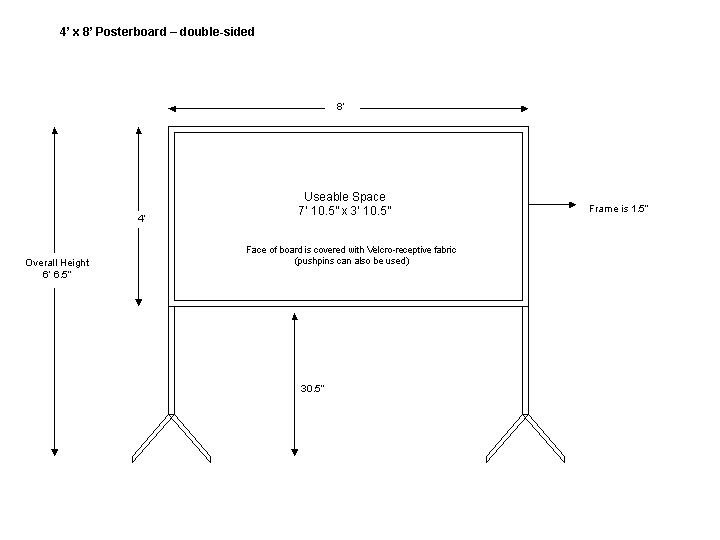
Size: Poster should be horizontal (landscape) format with a maximum size of eight feet wide by four feet tall. Below is what the poster board will look like, for reference (ignore the Velcro comment – we use pushpins):
Printing: You need to bring the printed poster with you. We recommend using your trusted printer at home & bringing it as a carry-on item on the plane in a poster tube. If that’s not possible, you can find a local printer near the property, but please keep the turnaround times and expenses in mind.
Poster Session: Posters should be posted up no later than 30 minutes before your session and taken down within an hour following the session. All posters left after this time will be discarded.
All poster boards will be numbered by APPAM, indicating assigned poster spaces for each session. You will receive your specific assignment location in late October or early November. Thumbtacks will be provided to put up your poster. Please do not use tape, staples, or any other adhesive to hang your poster.
Conference Submission FAQs Questions
Questions about the conference should continue to be directed to [email protected].
In order to submit you will need the names, email addresses and affiliations of presenting authors. You will also be asked to submit the following:
- Panel Title
- Overall Panel Abstract (no more than 500 words)
- Paper Titles (3-4)
- Paper Abstracts (no more than 500 words each)
- Presenting Author Contact Information
- One chair and one or two discussants
- One session organizer
A strong panel contains three or four papers, a chair and at least one, but no more than two, discussant(s). A panel with four papers is encouraged to have two discussants but again, only one is required. The panel abstract ties the papers together and clearly indicates how the panel relates to the conference theme and the selected policy area. Strong panels include a diverse range of participants, crossing lines of gender, race, affiliation and research methods and perspectiv
One of the most challenging aspects of putting together the fall conference is identifying knowledgeable attendees who are willing and able to serve as chairs and/or discussants. By requiring you to identify a chair and discussant at the time of submission you are assisting committee members and staff in creating complete and focused panels early on. When including a chair and discussant on your panel, make sure the people identified know you have listed them. We contact all listed chairs and discussants when we sent out acceptance notices and it is very difficult to explain to listed participants that they were listed as a chair or discussant by the submitter when they were unaware and are unwilling to participate. When selecting chairs and discussants, please make sure they know they will be required to pay a registration fee to participate in the conference.
Roundtable submissions are discussion-based sessions that require the following:
- Roundtable Title
- Abstract of the Session (no more than 500 words)
- 2-4 Speakers with contact information
- One Moderator with contact information (who is not a speaker in the session)
- One organizer with contact information
You can also view the steps here.
Acceptances/rejections be sent out in July.
Sometimes, upon careful review, the Program Committee decides that a panel would be stronger if certain papers or participants were removed or replaced. This occurs for diversity, to increase panel cohesion, or to vary perspectives on a topic. When this happens, they assemble an alternative panel using available papers to create the strongest possible program for attendees. When altering a panel, program committee members may also change the panel title, replace the chair and/ or discussant(s), and reclassify the panel as belonging to a different policy area.
You will be asked to select a primary policy area, based on the policy areas identified for the Fall Research Conference. You will have the opportunity to identify a second area where your submission may fit. Please note that your submission will only be reviewed and accepted under one policy area. However, conference attendees will be able to search for your session using both policy areas in the online program.
If you are experiencing technical difficulties, please contact please contact [email protected].
No, you do not. During the submission process, you can “suppress and continue” your submission until you get to the last page of the submission page, where you can select “Save and Finish Later”. Please note that if you do not follow these steps, your submission will not save, and you will have to restart the process.
You can check if you have an APPAM MemberClicks profile here. You can also email APPAM directly.
Chairs introduce the session topic & speakers, outline the panel format, help keep speakers on schedule, and ensure there’s at least 20 minutes of audience Q&A at the end.
Discussants read the assigned panel papers and prepare thoughtful questions and feedback for their designated ~20-minute period. Discussants should encourage active audience participation and ensure there’s at least 20 minutes for Q&A at the end.
Look for more information on signing up in July.
Fully submitted panel submissions have an average acceptance rate of 66% compared to 47% for single paper submissions. Check out the Single Paper Listing under the Submitter Menu in the All Academic submissions system to find other similar papers and re-submit your work as a panel. This listing includes the policy area, abstracts, and contact information for each single paper submitted for inclusion in the Fall Research Conference.
The Single Paper Listing will be opened in mid-February, and will be updated weekly through the submission deadline.
If you submitted a single paper that you now want to use as part of a panel, you need to withdraw the paper and resubmit it as part of the panel. Papers cannot be submitted twice.
All active conference participants must register, pay the full conference registration fee, and attend your scheduled session.
- Active session roles include:
- Panels – Chairs, discussants, presenting authors
- Roundtables & Workshops – Moderators and speakers
- Posters & Papers – Presenting authors
- Inactive session roles do not need to register or attend the conference. These roles include:
- Panels – Submitters, organizers & co-authors
- Roundtables & Workshops – Submitters & organizers
- Posters & Papers – Submitters & co-authors
Full papers do not need to be shared until one-month before the conference. Most authors choose to upload their papers into the Online Program so they’re available for download. If you do not want your paper to be made public, you will be required to share it directly with your discussant so they can prepared feedback.
The 2025 APPAM Fall Research Conference is scheduled to be fully in-person at this time.
APPAM is seeking workshop proposals that will take place during regular conference programming over a 90-minute timeslot. Workshops should be interdisciplinary, hands-on and interactive or focused on a special interest or skill training topic. Workshop proposals must include one moderator/facilitator and up to four speakers.
The APPAM Conference Submission Portal will be your access point for all your submissions and sessions you are part of. Please make sure that you use the same email address for all associated a role, such as presenting author, session chair, or moderator. With this portal, you can view and modify all your abstract submissions and associated roles in one place.
No, a paper can only be submitted once. All paper submissions are automatically considered for all submission types. Any duplicate submissions will be removed.
New in 2025, co-authors can only be added after the paper is accepted to the conference.
APPAM will post a call for Late-Breaking Roundtables, timely policy-related research topics that have arisen since submissions closed in April, from late August through late September. Notices will be sent in mid-October.
Can’t find what you are looking for?
Questions?
Questions about the conference should continue to be directed to [email protected].