Below you can find important information on how to make the most out of your experience this November. All events will take place in US Eastern Time. Please view the participant guidelines below for more information on your role at #2026APPAM.
Important Dates
Important Participant Dates
| August 31 |
Participation Confirmation Deadline |
| September 15 |
Participant Registration Deadline |
| October 20 |
Paper Upload & Session Edit/Changes Deadline |
Session Types
Session Types
-
Communities: These one-hour gatherings are informal meetups for specific shared interest topics. These sessions are discussion-based and they should not include a formal presentation.
-
Late-Breaking Roundtables: These sessions will be selected during a separate submission process in September 2026 to include timely policy-related research topics that have arisen since submissions closed in spring 2026. These sessions will follow APPAM's usual Roundtable format.
-
Lightning Sessions: These panels are organized by policy area and will feature a broad range of topics, with up to six papers, a session chair, and no discussants. Since there are no discussants, the papers do not need to be shared before the start of the conference, but uploading the Online Program papers is still recommended so the audience can access them.
-
Panel: A panel includes a session organizer, a chair, one to two discussants, and three to four papers. Panels with four papers are encouraged to have two discussants. Presenting authors may not serve as the chair or discussant on the same panel.
-
Poster: Poster sessions are single-paper presentations that are presented in a poster format. Presenters will be asked to discuss their work and answer questions during one of two poster sessions.
- Roundtable: Roundtables do not include papers; rather, they feature speakers who discuss a topic from various perspectives and draw the audience into a discussion. Roundtable presentations include up to four speakers plus a moderator.
-
Workshops: Workshops are extended sessions and should be interdisciplinary, hands-on, and interactive, or focused on a special interest or skill training topic. Workshop proposals include one moderator/facilitator and up to four speakers.
Session Formats and Presenter Timing
Session Formats and Presenter Timing
-
Below are guidelines for well- timed sessions; these sample sessions run from 10:15 – 11:45 am.
|
Three to Four Paper Panel
|
Three Speaker Roundtable
|
|
10:15 - 10:20 - Chair introduces the participants & topic
10:20 - 10:35 - First paper
10:35 - 10:50 - Second paper
10:50 - 11:05 - Third paper
11:05 - 11:25 - Discussant(s) presents their comment (5 minutes per paper)
11:25 - 11:45 - Audience Discussion
Sessions with four papers should allow each 12 minutes for each paper presentation.
|
10:15 - 10:20 - Moderator introduces speakers & topic
10:20 - 10:35 - First speaker
10:35 - 10:50 - Second speaker
10:50 - 11:05 - Third speaker
11:05 - 11:25 - Moderator presents their comments
11:25 - 11:45 - Audience Discussion
Sessions with four speakers should allow each 12 minutes for each speaker.
|
|
Lightning Sessions
10:15 - 10:20 – Chair introduces the participants & topic
10:20 - 10:31 – First paper
10:31 - 10:42 – Second paper
10:42 - 10:53 – Third paper
10:53 - 11:04 – Fourth paper
11:04 – 11:15 – Fifth paper
11:15 - 11:26 – Sixth paper
11:26 - 11:45 – Audience Discussion
Lightning sessions with less papers should reserve 5-minutes for introductions, 20-minutes for audience discussion, then split the remaining time evenly amongst the papers. There are no discussants.
|
|
If you have any questions, please contact [email protected].
Speaker Center
Speaker Center
-
Speaker Center serves as your hub for managing all your acceptances. In this section, you can confirm/decline your participation(s), make any necessary edits to your paper, and upload a copy of your paper.
Important Speaker Center Note: Please email [email protected] if you have more than one All Academic account. You may have multiple accounts in the system and they must be merged.
Speaker Center Actions:
How to confirm your participation in the All Academic Speaker Center:
Who can accept or decline a role:
- Session Organizer
- Discussant
- Panel Chair
- Moderator
- Speaker
- Presenting Author
- If a presenting author declines to present or removes themselves as an author, the paper will be removed from their list of accepted roles.
- Co-authors
- Co-authors have no active role in the session and cannot confirm their participation but can make edits to their paper
How to make edits to your paper and upload a copy of your paper:
Who can edit papers:
Available paper edits:
- Edit paper title
- Edit paper abstract
- Designate new panel presenting author
- Add/remove co-authors
- Add or remove keywords
- Upload your paper
How to make edits and upload your paper:
- Click on “Edit Paper" or "Upload Paper" next to your accepted paper
- Make your edits and/or upload your paper and save
Making Edits to your Paper or Session as a Session Organizer or Co-author
Making Edits to your Paper or Session as a Session Organizer or Co-author
Participant Guidelines
Participant Guidelines
-
These guidelines apply to all APPAM conference participants, including presenting authors, chairs, discussants, speakers, moderators, and poster presenters. Below, you can find detailed information on each session role, and helpful speaker best practices here.
In order to encourage interdisciplinary discussion among conference participants and audience members, we want to encourage:
- Interaction among session participants beforehand in order to maximize audience participation on the day of the session.
- Distillation of the research, by the discussant(s), to identify its unique contribution to policy.
- Identification of relationships among the research presented, either by the presenters themselves or by the discussants.
- Give-and-take among participants—especially between researchers and practitioners.
- Creation of an environment to enhance understanding of issues and the attendant research informing them.
As you prepare for your session at the conference, please keep the following points in mind:
- APPAM members like to talk and react. Members include many experts; session participants consistently praise APPAM conferences for the exceptional level of professional interaction. Much of this interaction occurs within, or is stimulated by, the session discussions. With this in mind, please allow a full 20 minutes for audience questions and commentary. This 20-minute period is separate from the time normally accorded to panelists responding to the discussant's comments.
- Please see the session format grid below for recommended presentation time limits and confirm timing with fellow speakers. Session contact information can be found in the All Academic Speaker Center. The discussant should be granted roughly as much time as a presenter. Multiple discussants should divide this allotted time among themselves.
- If they are to provide useful insight to authors and serve as stimulants for audience follow-up, discussants must receive papers no later than two weeks prior to the conference. This will allow for adequate time for discussants to read the session papers. Presenters will receive instructions on how to upload papers in All Academic Speaker Center and are urged to do so by the deadline provided so discussants have enough time to read the papers and prepare comments before the conference.
- An excellent panel session is one in which the presenters focus on the most important issues in their research and, with the aid of the discussant(s), collectively highlight connections among the papers presented. The conference should be an opportunity for professional development in which presenters and session audiences interact to enhance understanding of the issues. Your cooperation with the guidelines in this memorandum will help create an environment in which this can occur.
Presenter Guidelines
Presenting Author Guidelines
-
You can find contact information for all session participants in your Confex Speaker Center. Please reach out to your chair to let them know the status of your paper and when you plan to upload it for the discussant. If your paper is not ready to be posted publicly, you can share it privately with the discussant, but you must do so by the submission deadline to give them adequate time to prepare comments.
The following format is suggested, as it has been found to work well within the 12-15-minute time frame you are allotted for your presentation.
Organization: Begin with a one-minute overview summary of the paper that includes the central question addressed and the major conclusions. To the extent possible, these conclusions should include policy implications.
Explanation: Follow with the reasons listeners ought to accept the paper's conclusions: the underlying theory, description of the evidence, methodological defense of the evidence, and connection to (and improvement upon) the existing literature. This manner of exposition differs from that of a journal article, but it is more appropriate to a conference format. Speaking is a more effective way to get an explanation across than reading.
Slides: It is highly recommended to use slides. Try to economize on the number of slides in a presentation. Slides should be readable from at least 30 feet away (some of the presentation rooms are quite large, others are small), and should be displayed long enough for viewers to actually comprehend the message they are supposed to convey. A good rule of thumb is one substantive slide (a key exhibit, not an outline page) for every two minutes of presentation (or no more than six or seven total slides per presentation). Slides should serve as an aid, but should not be read from directly.
Additionally, please review the speaker's best practices.
Technology: Sessions must bring one presenter's laptop and one flash drive with pre-loaded slides for all presenters. Do not rely on cloud storage or streaming options, as conference internet connections may cause presentation delays. Meeting rooms will be equipped with an HDMI cable to connect the laptop to the projector, so an HDMI-port laptop is strongly recommended. If an HDMI-port laptop is unavailable, you can request a different cable from on-site tech support. There will be a tech support contact information sheet located in each meeting room if you need assistance.
There will be 15 minutes or less available to set up presentations before most sessions begin. With strict 90-minute time slots, even a minor delay can greatly hamper a session's success.
Speaker Guidelines
Speaker Guidelines
The speaker is critical to the success of a roundtable, workshop, or Communities session. The speaker participates in a discussion about a specific topic, question, or issue. APPAM asks speakers to do the following:
- Prepare and provide a brief opening statement along with general remarks
- Answer questions posed by the moderator
- Keep your remarks within your allotted time
- Engage with the audience and provide takeaways for the audience
- Be prepared to initiate the question period if the audience is not engaged
Moderator Guidelines
Moderator Guidelines
The moderator is critical to the success of a session. The moderator makes sure that the session runs smoothly, makes a quick introduction of each speaker in the session, and facilitates the conversation. APPAM asks moderators to do the following:
- Convene the panel, either by email or conference call, in advance to discuss presentation format, talking points, and questions.
- Start the session on time and state the ground rules at the beginning of the discussion, including timing and commitment to the discussion. Note that observing stated time limits shows respect for other presenters and for the audience.
- Introduce all participants at the beginning of the session.
- Monitor the clock. Speakers who appear to be off track to complete on time should be cautioned mid-presentation. APPAM will supply moderators with four signs that read, "5 minutes," "2 minutes", "1 minute", and "Stop" to help alert presenters to their timing.
- Moderators should sit in the front row of the audience, facing the presenters, rather than at the head table, during presentations.
- Be prepared to initiate the question period if the audience is not engaged, and ensure that questions and statements from the audience are short and to the point.
Chair Guidelines
Chair Guidelines
The chair can be critical to the success of a session. The principal challenge for a chair is to enforce time allotments. A presenter who runs over their allotted time is using time that belongs to another presenter or the audience. APPAM asks chairs to do the following:
- Monitor paper progress before the meetings and encourage the timely distribution of session papers to all discussants.
- Ensure that presenters upload papers to the All Academic Speaker Center for discussants to read in advance of the conference. If they have not by October 30, 2026, please bring this to the attention of [email protected].
- Convene the panel in advance to make introductions and develop some rapport.
- You are encouraged to consider an alternative format if the panelists agree; for example, having a discussant summarize all the papers at the beginning of the session. These alternative formats can help facilitate audience participation and discussion.
- Start the session on time and state the ground rules at the beginning of the discussion, including timing and commitment to the discussion. Note that observing stated time limits shows respect for other presenters and for the audience.
- Introduce all participants at the beginning of the session.
- Monitor the clock. Presenters who appear to be off track to complete on time should be cautioned mid-presentation. APPAM will supply chairs with four signs that read, "5 minutes," "2 minutes", "1 minute", and "Stop" to help alert presenters to their timing.
- Chairs should sit in the front row of the audience, facing the presenters, rather than at the head table, during the presentations.
- Do not ask the panelists to respond to the discussant(s) comments. Instead, move quickly to an open discussion that involves the audience.
- Be prepared to initiate the question period if the audience is not engaged, and ensure that audience questions and statements are short and to the point.
Discussant Guidelines
Discussant Guidelines
Discussants play a critical role in determining the quality of audience participation in the session. Discussants should be aware of the time limits above. Please allow yourself at least two weeks to read the papers for the sessions and to formulate comments that tie the papers together before the conference. If the presenter(s) have not uploaded their paper(s) or sent them to you privately by October 30, 2026, please let the APPAM office know at [email protected].
The bulk of the session should be spent encouraging audience participation. Discussants should also keep the following in mind:
- Discussants are asked to make integrative comments rather than paper-by-paper critiques. In many cases, very specific or detailed criticisms can be shared with paper authors outside of the session. See the above grid for suggested discussant comment time limits.
- If there are two discussants for a session, please contact the other discussant and determine how you will split the responsibility of reading/providing commentary for the papers in your session. Contact information can be found in the All Academic Speaker Center.
- Discussant remarks on each paper should address the major issues that enhance or undermine the paper's contributions, reserving minor issues for direct communication with the authors.
- Discussants are encouraged to help shape the audience participation in the session by identifying key points worthy of further analysis and discussion.
- Discussants should contribute to the session's policy focus. To further this endeavor, here are some questions to consider and use for audience discussion:
- Does the research inform policy in the most timely and useful way? If not, what could be done to improve the contribution of research to policy?
- Are the methods used in the research and analysis properly aligned to the nature of current policy problems?
- Do we need to rethink the roots of the policy problems we are researching? Are we missing research opportunities because we have become too comfortable with our research designs and communities?
- How can we draw on the expertise of public managers and political scientists to inform our research?
- Are there emerging policy problems for which we are not producing useful research, but for which we could direct new research?
- Are there limitations of information, data, and research designs that prevent their research from being used by policymakers?
- What common challenges have researchers encountered when studying the issue?
- How can we address these challenges in future research?
Poster Guidelines
Poster Guidelines
Size: Poster should be horizontal (landscape) format with a maximum size of eight feet wide by four feet tall. Below is what the poster board will look like, for reference (ignore the Velcro comment – we use pushpins):
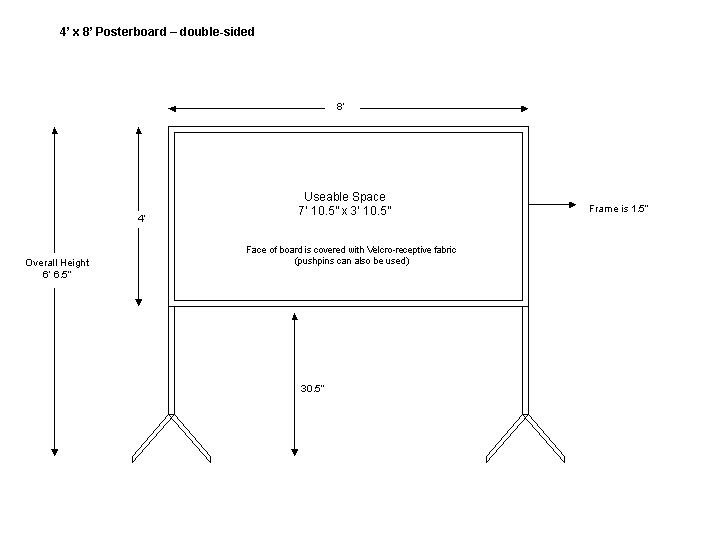
Printing: You need to bring the printed poster. We recommend using your trusted home printer and bringing it as a carry-on in a poster tube. If that’s not possible, you can find a local printer near the property, but please keep in mind the turnaround times and expenses.
Poster Session: Posters should be posted no later than 30 minutes before your session and taken down within an hour after the session. All posters left after this time will be discarded.
All poster boards will be numbered by APPAM, indicating assigned poster spaces for each session. You will receive your specific assignment location in late October or early November. Thumbtacks will be provided for putting up your poster. Please do not use tape, staples, or any other type of adhesive to hang your poster.
Workshop Guidelines
Workshop Guidelines
There will be four daily workshops at the #2026APPAM conference, running concurrently with regular sessions. These workshops should be very hands-on and interactive, with ample time for audience discussion and participation.
Timing: Below is an example of a well-timed workshop for the 8:30 – 10:00 am timeslot and includes three topics; however, workshop agendas will vary greatly.
8:30 - 8:40 - Introductions, agenda, and goals for the day (10 minutes)
8:40 - 9:05 - Topic/breakout one (25 minutes)
9:05 - 9:15 - Regroup for Q&A/audience discussion (10 minutes)
9:15 - 9:35 - Topic/breakout two (20 minutes)
9:35 - 9:45 - Regroup for Q&A/audience discussion (10 minutes)
9:45 - 10:00 - Wrap up, next steps, etc. (15 minutes)
Room Set:
- Workshop rooms will have a projection, a podium with a mic, and a head table for four with two shared tabletop mics at the front of the room.
- The audience will be set in rounds of eight with one shared floor mic.
- We are unable to accommodate special room set requests, and facilitators must return furniture to the existing room set at the conclusion of each workshop.
Supplies:
- APPAM provided:
- Standard conference wireless internet will be available in the meeting room, but it's not suitable for streaming, so please have all materials downloaded before arriving.
- Four flip charts and markers will be provided to help facilitate hands-on learning and breakout group opportunities.
- 5-minute, 2-minute, and stop signs will be provided by APPAM for the moderator to utilize.
- No food, drink, or additional supplies will be provided by APPAM.
- Facilitator provided:
- Laptop computer with materials downloaded & readily accessible (HDMI preferred but alternative cables available, as requested)
- Slide advancer (optional)
- Other materials as needed, e.g., printouts, pens, paper, forms.
Pre- & Post-Workshop Communication:
- Workshops do not have registration/RSVPs, so facilitators cannot communicate via email.
- Facilitators may upload hand-outs and provide detailed agendas by updating the Workshop submission in Speaker Center (see above).
- Facilitators are welcome to collect names & emails on a voluntary basis during their workshops for post-event communications, but APPAM is unable to assist with the collection or distribution of materials.
Tips:
- Plan out talking points, speaking order, & allotted speaker time, then host a dry run.
- The moderator should track time and give prompts throughout the workshop to keep speakers on schedule. The moderator may use the provided 5/2/stop signs.
- Plan for attendees to come and go throughout the session. Keep the rotating audience in mind if assigning breakout groups.
- From Community Toolbox, workshops should be:
- Participatory - Participants are active, both in influencing the direction of the workshop and in having a chance to practice what's being discussed.
- Informal - There's a good deal of discussion and participation, rather than just presenting material.
- Self-Contained - Although a workshop may end with handouts and suggestions for further reading, the presentation should stand on its own and require minimal homework.
- Vary your presentation methods and activities – This will help keep people focused, address different participants' learning styles, and make the workshop more interesting and fun. Consider:
- Hands-on activities that are appropriate for the designated room set (see above).
- Include both group and individual activities.
- Activities should be entertaining and interactive. Avoid being a "talking head" as much as possible.
- Include various kinds of audio-visual material, such as highly visual but limited slides, video, motion graphics, and audio recordings.
- Include practice of a particular technique or method that's being presented, even if only for a short time, to give participants the chance to see what it feels like.
Communities Guidelines
Communities Guidelines
The Community Lounge is intended to be a casual networking space. These one-hour informal meet-ups are discussion-based for shared interest topics and should not include formal presentations, slides, or speakers.
Organizer Tips:
- Do not prepare slides or speakers.
- Prepare for both guided and organic discussions.
- Discussions can take place in a large-group format or in breakout groups, with or without prepared talking points.
- Prepare to help spark conversation and keep it going as needed. Some quieter gatherings need a conversation boost from the organizer(s).
- Ensure all attendees are welcomed and engaged throughout the 60-minute event.
- At the conclusion of the event, please return the furniture to its original position so the room is ready for the next gathering. If you provided handouts, please collect them and take them with you, but leave the lounge sponsor materials behind.
Room Set:
- Podium with one mic at the front of the room
- Large lounge area in the center of the room for large group discussions
- Tables & chairs along the perimeter of the room for breakout group discussions or overflow for large group discussions
- The Communities Lounge does not include a projection or TV for slides, catering, or a head table/chairs for speakers.
___________________________________________________________________________________
If you have any questions about the above information, please contact [email protected]