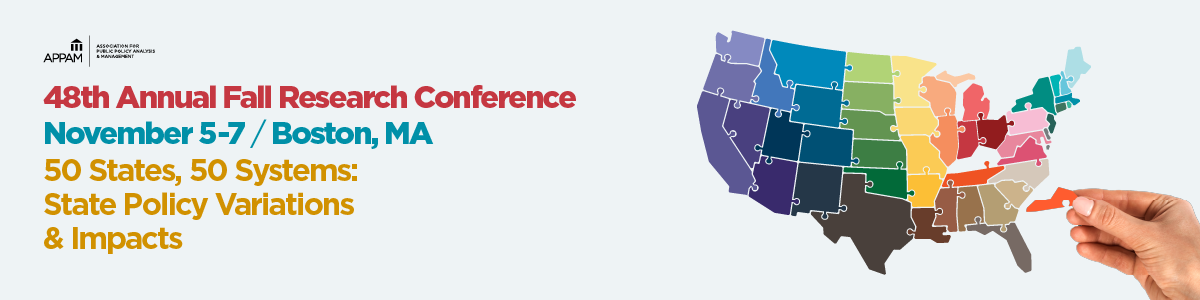
Fifty States, Fifty Systems: State Policy Variations and Impacts
November 5 - 7 | Marriott Copley Place | Boston, MA
The US federalist system of government assigns substantial authority to states to create and implement policies. At this time, as the federal government's role is shrinking, the role of state policy is even more important. Ideally, states make laws based on the unique needs and conditions of their state; however, throughout history and continuing today, state policies vary considerably in their reach and generosity, and not always in ways consistent with the economic, environmental, or social needs of states, but rather in the ideology of state leaders. Measuring state-level variation and its impact on well-being is more important now than ever, and policy scholars bear responsibility for it.
Proposal Submission Types
Submissions are being solicited for the #2026APPAM. Every session during the conference will be categorized into a primary policy area.
- Panel: Panels include a session organizer, chair, one to two discussants, and three to four papers. Panels with four papers are encouraged to have two discussants. Presenting authors may not serve as the chair or discussant on the same panel. Individuals may present on up to two panels throughout the conference, though they may serve as a chair or discussant unlimited times. There should be no more than two people per affiliation per submission.
- Poster: Poster submissions are single-paper proposals that are presented in a poster format. Presenters will be asked to discuss their work and answer questions during one of two poster sessions. The poster should be in a horizontal (landscape) format, with a maximum size of 8 feet wide by 4 feet tall.
- Roundtable: Roundtables do not include papers; rather, they feature speakers who discuss a topic from varying perspectives and draw the audience into a discussion. Roundtable proposals should include up to four speakers plus a moderator. The moderator cannot also be a speaker in the same session. There should be no more than two people per affiliation per submission.
- Single Papers: Single papers are proposals that will later be combined with other single papers to form cohesive panel sessions on a single topic. See below to learn more about submitting a single paper.
- Student Research: APPAM is pleased to once again accept student research paper submissions at the Fall Conference. Submitted research must have been conducted by a current student or recent graduate student. Student research submissions will be combined to form a cohesive panel with four student research papers, a chair, and up to two discussants. These sessions will take place throughout the conference.

Submissions are being solicited in the following policy areas for the #2026APPAM. Submitters can select both primary and secondary policy areas, as we recognize that research isn't always limited to a single area. This helps the Program Committee place submissions in the best-suited policy area. Every session during the conference will be categorized into one of these primary policy areas.
Keyword Program Flags: Submitters may select up to three keywords that best describe their submission topic. These selections will serve as program flags, allowing conference attendees to narrow their search beyond the broad policy areas below. Session filters will be available in the Online Program and in the conference mobile app. Keywords are an optional new feature and will not be used in the review process.
- Crime, Justice, and Drugs (CRIME)
This policy area includes, but is not limited to, research on the following issues: Drug use and legalization, incarceration effects, prisoner outcomes, police and court processes, international crime, black markets, corruption, rehabilitation programs, recidivism, human rights abuses, etc. May overlap with Employment and Training Programs on prisoner re-entry and job training.
- Education (EDU)
This policy area includes, but is not limited to, research on the following issues: Head Start, pre-K, kindergarten, elementary education, high school, college, student loans, school and teacher accountability, disadvantaged students, charter schools, grants and financial aid, teacher evaluation and effectiveness, curriculum, student achievement and attainment, class size and composition, after school and summer programs, Veterans (GI Bill), arts and culture programs in schools, etc.
- Employment and Training Programs (EMP)
This policy area includes, but is not limited to, research on the following issues: Unemployment, underemployment, re-training programs, veterans transition to civilian careers, workplace accommodation for persons with disabilities, earned income tax credit (EITC), the Child Tax Credit and the Additional Child Tax Credit, unemployment insurance, internships, apprenticeships, outsourcing, etc. May overlap with Social Equity on affirmative action and diversity hiring programs. May overlap with Crime and Drugs on prisoner re-entry and job training.
- Family and Child Policy (CHILD)
This policy area includes, but is not limited to, research on the following issues: Marriage and marriage education, child support enforcement, child care access, child care subsidies and quality, infants and toddlers, child wellbeing, parental education and employment, vulnerable children and families, school readiness, intergenerational mobility, childhood hunger, family resource and income management, familial immigration concerns, single parent and child custody issues, family planning, etc.
- Health Policy (HEALTH)
This policy area includes, but is not limited to, research on the following issues: Medicare, Medicaid, the Affordable Care Act (ACA), barriers to health care access, wellness programs for aging populations and persons with disabilities, rehabilitation programs for veterans, obesity and nutrition (exclusive of SNAP and WIC), reproductive health, health care costs, physician behaviors, health literacy, alcohol, drug and tobacco use, arts programs as rehabilitation, etc.
- Housing, Community Development, and Urban Policy (HOUSE)
This policy area includes, but is not limited to, research on the following issues: Housing stipends, Section-8 housing, community development plans to alleviate crime and poverty, foreclosures, home ownership, relocation assistance, Federal Housing Assistance Loans (FHAs), mortgage assistance, home owner and rental insurance, veterans housing programs, etc.
- Innovations in Science and Technology (SCI)
This policy area includes, but is not limited to, research on the following issues: artificial intelligence (AI)*, science as evidence in policymaking; resource allocation related to science, technology, innovation, and economic development; knowledge management within and across organizations and national borders.
- Methods and Tools of Analysis (METH)
This policy area includes, but is not limited to, research on the following issues: Methods of analysis, big data, new and existing data sources, data comparisons, program monitoring tools and dashboards, data collection and structuring, research design, policy informatics, computational modeling, system dynamics, data visualization, applications of analytic methods, evidence-based decision making, estimating causal effects, assessing bias, etc.
- National & Homeland Security and Crisis Management (SEC)
This policy area includes, but is not limited to, research on the following issues: core security issues such as traditional intelligence and defense analysis, international security problems in general, homeland security, disaster, crisis, and emergency preparedness and management, and emerging issues such as peace operations and intricacies of information warfare.
- Natural Resource, Energy, and Environmental Policy (ENV)
This policy area includes, but is not limited to, research on the following issues: Energy options and use; new energy sources; pollution; waterways; conservation efforts; protected land and species; natural resource scarcity and management; green economies; land reform; climate change; sustainability, etc.
- Politics, Media, and the Policy Process (POL)
This policy area includes, but is not limited to, research on the following issues: Implementing policy, policy reform, policymaking, policy procedures, political participation in policy, policy analysis, accommodating changing attitudes, grant policies, policy across all levels of government: federal, state and local, government efficiency, participation in governance, bureaucracy, intergovernmental relations, budget allocations, the effect of politics on policy, elections, global politics, the role of media in the policy process, etc.
- Population and Migration Issues (POP)
This policy area includes, but is not limited to, research on the following issues: immigration trends; culture; population growth and decline; aging populations; policy responses to demographic changes; minority and immigrant migration; labor migration across borders, etc.
- Poverty and Income Policy (POV)
This policy area includes, but is not limited to, research on the following issues: Food insecurity, the Supplemental Nutrition Assistance Programs (SNAP), the Women, Infants and Children (WIC) program, Home Energy Assistance Programs (HEAP), welfare, school breakfast and lunch programs, personal retirement planning and income, impacts on poverty and inequality, the Great Recession outcomes, Temporary Assistance for Needy Families (TANF), poverty reduction programs, savings and asset accumulation, disaster assistance, veterans assistance, disability programs including Social Security Disability Insurance and Supplemental Security Income, international development, etc.
- Public and Nonprofit Management and Finance (PM)
This policy area includes, but is not limited to, research on the following issues: Performance management, citizen assessments of public performance, measuring efficacy of federal, state and local programs, block grants, intergovernmental finance, nonprofit management and finance, program implementation, citizen engagement, tax policy, knowledge management, public information sharing, budget cuts, government priorities, etc.
- Social Equity and Race (SEQ)
This policy area includes, but is not limited to, research on the following issues: Gender (including transgender and non-binary gender identification), race, religion, national origin, ethnicity, immigration, and LGBTQ issues, affirmative action and diversity programs, etc. May have overlap with Employment and Training Programs on affirmative action and diversity hiring programs.
Crime, Justice, and Drugs (CRIME)
Education (EDU)
Employment and Training Programs (EMP)
Family and Child Policy (CHILD)
Health Policy (HEALTH)
Housing, Community Development, and Urban Policy (HOUSE)
Innovations in Science and Technology (SCI)
Methods and Tools of Analysis (METH)
National & Homeland Security and Crisis Management (SEC)
Natural Resource, Energy, and Environmental Policy (ENV)
Politics, Media, and the Policy Process (POL)
Population and Migration Issues (POP)
Poverty and Income Policy (POV)
Public and Nonprofit Management and Finance (PM)
Social Equity and Race (SEQ)
APPAM is now looking for volunteers to serve as reviewers for the 2026 APPAM Fall Research Conference. Reviewers will be assigned a set number of submissions to review and grade on five criteria, in addition to providing comments that will help guide the policy area chairs in their final recommendations. The number of submissions depends on the size of the policy area and the number of reviewers for that year. We will do our best to accommodate all applicants, but completing the volunteer form does not guarantee your participation as a reviewer.
Reviewer Volunteer Commitment: 2 – 6 hours in April 27– May 28, 2026
Reviewer Requirements:
- Current Professional or Retired APPAM member
- Current Student members - Masters and PhD students that apply must have at least 3 years research or professional experience in policy or related fields.
Please note that if you do not have a current paid APPAM membership, you will not be able to complete the form.
Questions about your membership status? View your membership status here:
https://appam.memberclicks.net/login#/login
To sign up to be a reviewer, login into your All Academic Portal and select "Volunteer to be Reviewer" under your Submitters Menu.
APPAM is using All Academic as our conference submission platform. All conference participants (presenting authors, co-authors, panel chairs, discussants, moderators, speakers, and session organizers) will access the All Academic system using an APPAM MemberClicks login. Before you begin your submission, please ensure that everyone involved has an APPAM MemberClicks account. You will not be able to add them to your paper or session if they don’t have an existing account. MemberClicks account information:
- Please check whether you have a MemberClicks account here.
- You can request your username or reset your password if you do not remember them.
- Please check any emails that you have had professionally/academically in the past few years, as well as any personal emails.
- If you think you may have an account under an email address you no longer have access to, please contact [email protected] to update your email/username. Please do not create a new/duplicate account. If you have never attended an APPAM event or do not have an APPAM profile, you can create one here.
- APPAM membership is optional and is not required to submit or attend the conference. If you wish to proceed as a complimentary non-member profile, please select “No, thank you” from the dropdown menu on the form.
- The APPAM MemberClicks form requires confidential personal information. Please do not create a profile for someone else.
- New MemberClicks accounts are synced with All Academic every hour. As such, we encourage submitters who create new accounts to do so well in advance of the submission deadline.
As you prepare your submissions, we encourage you to review the Single Paper Listings for papers that may complement your proposal to ensure a complete panel. While we still encourage individual paper submissions, complete panels - three or four papers along a common theme with a chair and discussant - have a much better chance of being accepted for the conference. If there is a paper in the list in which you are interested, please contact the authors and see if they wish to have their work become part of your panel. All contact information is noted in the listing.
We hope this will encourage APPAM members and the public policy community at large to broaden their research networks and become familiar with peers doing important work around the world.
Single Paper Listing Tool
Found papers in the single paper listing that you want to add? Please reach out to the contact listed for the paper you would like to add and ask them to provide you with their All Academic Code/Paper ID and the original submitter email associated with the listing. Input both the code and the email address to automatically add the paper to your panel.
Add a Paper That Is Not Listed in the Listing
Want to add a submitted paper that is not part of the single-paper listing? Reached out to the original submitter of the paper and ask them to provide you with the All Academic Code/Paper ID and the email associated with the paper that you would like to add. Input both the code and the email address to automatically add the paper to your panel.
Note on the Original Submitter
If student Jane Smith has submitted a paper that her professor Lily Thomas will be presenting, she is the original submitter. You will need to enter the All Academic Code/Paper ID of the submission and Jane’s email to pull the paper into the panel. If David Thomas submitted a paper that he will be presenting, he is the original submitter. You will need to enter the All Academic Code/Paper ID of the submission and David’s email to pull the paper into the panel.

Please use the submission guides and video tutorial below for information on submitting using the All Academic system:
Here are a few helpful tips and resources for getting accepted to the conference:
- Submissions that demonstrate diversity in terms of organizational affiliations, professional roles, race/ethnicity, content, author/participant backgrounds, and/or ideology & methodology - through questionnaire answers - will be prioritized in the review process.
- Individuals may only serve as a presenting author on two panels throughout the conference, though they may serve in other roles unlimited times.
- Individuals may not serve as a chair or discussant for a panel on which they are also presenting a paper.
- The final phase of the acceptance process will specifically entail vetting submissions for the aforementioned types of diversity and multidisciplinary perspectives
- Fully formed panels have a higher acceptance rate. Single paper listings will be listed and updated weekly starting in late February.
APPAM Abstract Requirements
- Short summary of your research paper that is between 100 and 500 words long
- Title of 15 words or less
- Make sure to highlight why your research is important. Keeping your abstract clear and concise will really help it stand out.
- If you are submitting a panel, ensure there are no more than 2 people from the same institution.
Tips for a Strong Abstract
The abstract should be structured as follows:
- Introduction/Background: Give a quick overview of the topic and why it’s important
- Purpose/Research Question: What question are you trying to answer? /What problem are you trying to address?
- Methods: Explain how you did your research, noting the data collection and analysis that was involved
- Results/Findings: Share your results, even if they were unexpected. If you only have preliminary results, you can share that as well.
- Conclusion/Implications: Explain the importance and potential impact of the findings or the next steps if your findings were unexpected.
Panel, Poster, & Paper Submissions Review Criteria
All panel, poster, and paper submissions will be scored on a scale of 1 to 10, with one being unacceptable and ten being outstanding based on the following criteria:
- Policy relevance of the issue addressed
- Clarity of the “issue statement” (i.e., well-specified question and interesting evidence)
- Merit of methodology employed
- Results/Plan for collecting the results
- Conclusions
- Overall quality
Roundtable Submissions Review Criteria
All roundtable submissions will be scored on a scale of 1 to 10, with one being unacceptable and ten being outstanding, based on the following criteria:
- Policy relevance of the issue addressed
- Clarity of the “issue statement”
- Potential for attendee engagement and excitement
- Diversity of speakers and perspectives
- Overall quality
Questions?
Questions about the conference should continue to be directed to [email protected].